Software & Data
2026 · 6 tools
A document knowledge base that answers two ways
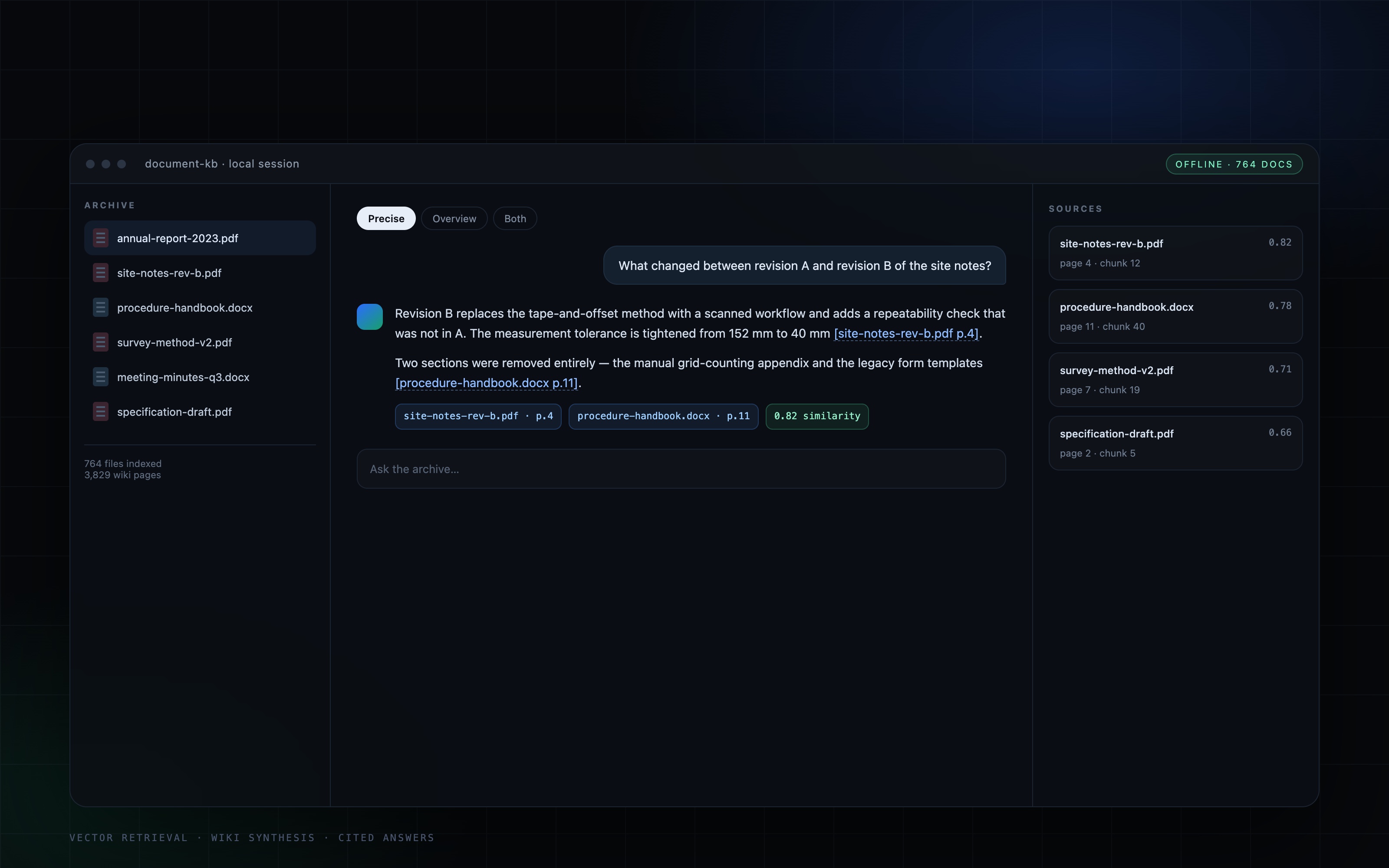
764 documents, two engines: exact passages from a vector index, or a synthesised overview built from a generated wiki.
scroll ↓
01 / the problem
A working archive of hundreds of files, and no reliable way to ask it a question.
- 764 files: 522 PDFs, 163 Word documents, 31 spreadsheets, plus email exports
- Many questions span documents — “what changed between revisions” defeats keyword search
- An answer is only useful if it can be traced back to a file and a page
- It has to run on one laptop, offline for retrieval, at no per-query cost
02 / approach
Design choices
Two engines instead of one: passages for precision, a wiki for synthesis
Local embeddings, so retrieval costs nothing per question
Content hashing, so updates only reprocess what actually changed
One shared module, so the chat UI and the agent follow identical rules
03 / workflow
How it runs in the field
Extract text from PDF, Word, Excel and email exports
Chunk with file and page metadata, then embed into a local vector store
Build a linked wiki from the same documents for overview answers
Expose both behind one chat UI with a Precise / Overview / Both switch
Publish retrieval as an agent tool so the same knowledge is queryable programmatically
04 / implementation
How it was built
architecture · tap any stage
One archive, two engines, one rule set.
Ingest
Extract · chunk · hash
pypdf · python-docx · openpyxl
- Text is pulled page by page, so a citation can point at a page, not just a file.
- Chunks are roughly 500 tokens and always keep their file name and page number as metadata.
- Each file is hashed, so a re-run only re-embeds what actually changed — seconds, not a rebuild.
local only · nothing leaves the machine
02 / 05
Ingest
pypdf / python-docx / openpyxlText is pulled page by page from PDFs, Word files and spreadsheets, then split into roughly 500-token chunks with the source file and page number kept as metadata.
Retrieval
bge-small + ChromaDBEach chunk is embedded locally into a 384-dimension vector store (288 MB). A question returns the closest chunks, each labelled with its file and chunk number.
Synthesis
OpenKB wikiThe same documents are processed a second time into a linked wiki of summaries, concepts and entities — the layer that can answer a question spanning twenty files.
Sync
content hashingEvery file is hashed. Re-running the updater re-embeds only changed files and adds only new ones to the wiki, so keeping it current is cheap.
Interfaces
Chainlit + MCPOne chat UI with three answer modes, and one agent tool exposing the same retrieval — both importing a single engine module so the rules cannot drift.
results
- 764
- Documents indexed
- 3,829
- Wiki pages
- 288 MB
- Vector index
- 3
- Answer modes
PDF · Word · Excel
generated
fully local
precise · overview · both
05 / tools & stack
What it was built with
Ingestion
- pypdf · python-docx · openpyxl
- Text extraction across 522 PDFs, 163 Word files and 31 spreadsheets.
- ~500-token chunking
- Chunks carry file name and page number, which is what citations are built from.
- Content hashing
- Decides what to re-embed, so updates take seconds instead of a full rebuild.
Retrieval
- BAAI/bge-small-en-v1.5
- Local 384-dimension embeddings — no API calls, no per-query cost.
- ChromaDB
- Local vector store (288 MB) holding the chunk index.
- Top-k with metadata
- Returns the nearest chunks with their source label, so every claim can be traced.
Synthesis
- OpenKB
- Builds the linked wiki — summaries, concepts and entities across the whole archive.
- 3,829 wiki pages
- The layer that answers overview questions no single chunk contains.
Interfaces
- Chainlit
- Chat UI with Precise / Overview / Both modes, web search and PDF export.
- MCP server
- Exposes search and status as tools, so an agent can query the same knowledge base.
- Shared engine module
- One file defines retrieval and answer rules for both front-ends.
Runs entirely on one laptop: local embeddings, local vector store, no documents leave the machine. The archive itself is not published — only the architecture and the numbers above.
next project